What would improve the case?
Recurring-revenue growth, customer expansion and execution against raised company guidance.
Did outperformance compensate for the size of the drawdowns?
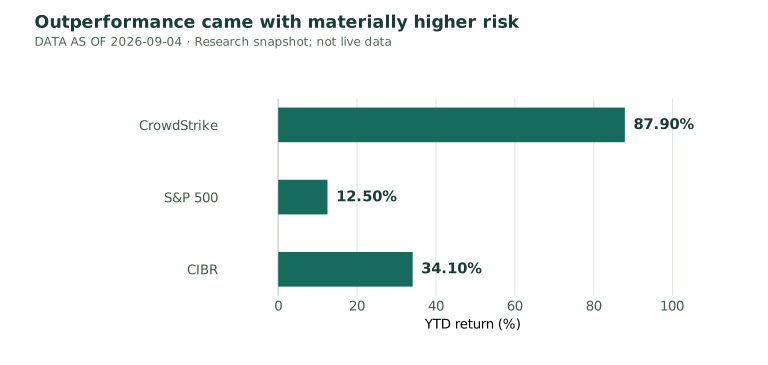
| Metric | CrowdStrike | S&P 500 | CIBR |
|---|---|---|---|
| YTD return | 87.9% | 12.5% | 34.1% |
| Annualized volatility | 60.3% | 13.4% | 32.0% |
| Maximum drawdown | −26.8% | −9.09% | −17.1% |
Recurring-revenue growth, customer expansion and execution against raised company guidance.
Valuation sensitivity, competition, service reliability and large price drawdowns.
My Python workflow, benchmark and peer comparisons, chart analysis and research interpretation.
YTD price window: 2 January–4 September 2026; yfinance end parameter 5 September is exclusive. Historical return is arithmetic annualized mean, not CAGR. Daily close-price calculations and benchmark choices follow the original notebook. Price-adjustment defaults must be pinned when rerunning.
Risk-free assumption: 4.79% annual assumption in the original notebook, held fixed across the analysis.
Sources and common conventions →The portable notebook reviews the dated summary inputs offline. The linked original repository contains the full workflow.